
The Elephant in the Room - iceberg model organizational leadership.
The Big Picture
I came across this image this week that stopped me mid-scroll.
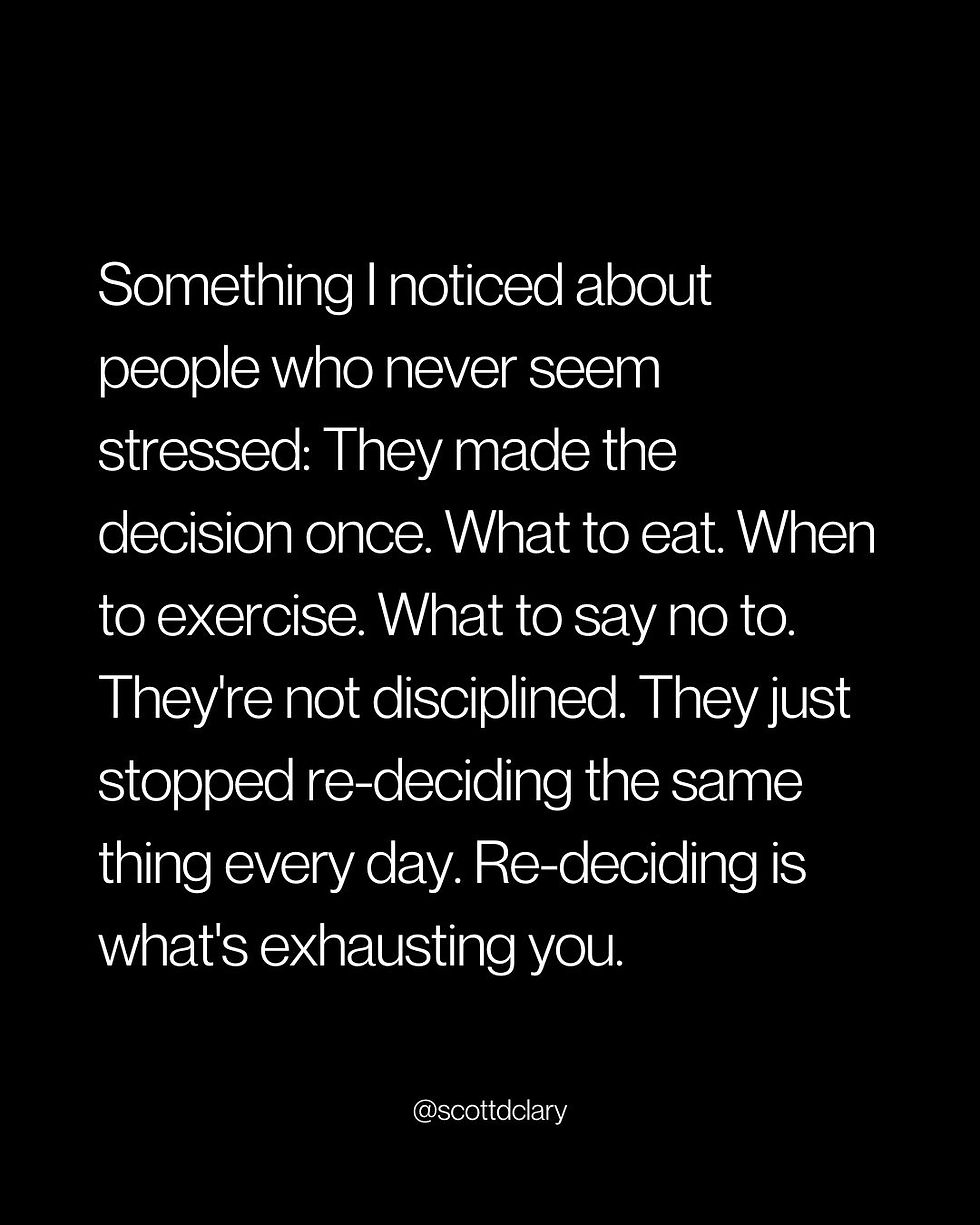
Scott D. Clary posted it on LinkedIn, and the words were plain enough that you could miss how much they were saying. "Re-deciding is what's exhasusting you." (Clary, 2024)
I sat with that for a while, because it is not just a personal productivity observation. It is a systems observation. The exhaustion Clary names is real, but it is not random. It is structural. It is what happens when a decision that should have been resolved at the root level keeps surfacing at the event level, dressed in new details, asking to be solved again.
In the context of building and leading organizations, that pattern points directly at a problem most founders will recognize the moment someone names it.
The team keeps solving the same problem. Production slows. Energy drains. People grow careful around each other. Conversations become managed rather than honest. And somewhere in the room, often in plain sight, everyone knows the real issue but no one is saying it out loud.
That is the elephant.
And the elephant does not disappear because the team works harder, moves faster, or adds another layer of process. It disappears only when someone is willing to go all the way down.
---
Dana Meadows was one of the clearest systems thinkers of the last century. Her iceberg model organizational leadership, introduced in Thinking in Systems: A Primer (Meadows, 2008), is simple enough to sketch on a napkin and precise enough to restructure how an entire organization thinks about itself. The model asks one foundational question: how much of what is driving this situation can we see?
The answer, in most organizations, is very little.

Layer 1 — The Event
The top of the iceberg is the event. The missed deadline. The product delay. The team meeting that ended without resolution. The client call that left everyone feeling vaguely unsettled and no one quite able to say why. Events are visible, concrete, and easy to react to. They are also the layer where most organizations spend most of their time, because events feel urgent and urgency has its own momentum.
But event-level intervention is, by definition, reactive. You are responding to the output of a system without examining the system itself. And a system that is not examined will keep producing the same outputs, regardless of how energetically you respond to each one.

Layer 2 — The Pattern
Below the event is the pattern. This is where a more useful question becomes available: not “what happened,” but “how many times has something like this happened, and under what conditions.” Meadows (2008) emphasized that patterns carry information events alone cannot. When a deliverable slips, that is an event. When deliverables of a certain type, under certain leadership conditions, in certain team configurations, slip repeatedly, that is a pattern. And a pattern is the system showing you its logic.
Most managers can identify a pattern if they slow down enough to look. Fewer are willing to ask what the pattern means.

Layer 3 — The Structure
Below the pattern is the structure. This is the design layer, and it is where the conversation must become more honest. Structure includes the formal elements: reporting relationships, decision rights, resource allocation, workflow design, approval chains. It also includes the informal ones: who holds influence, which concerns are safe to raise, what gets rewarded versus what gets penalized, which conversations happen in the meeting and which ones happen after it. Meadows (2008) was precise about this. Structure is not just the org chart. It is the full architecture of constraints and incentives that shape behavior, including the ones no one has written down.
Structure explains why the pattern keeps repeating even when everyone agrees it should stop. If the people in the system have good intentions, and they usually do, and the problem keeps recurring anyway, the problem is almost never the people. It is what the structure makes rational for them to do.

Layer 4 — The Mental Models
And at the deepest layer, where most teams and most leaders never go, are the mental models. The beliefs, assumptions, and unexamined convictions that drove every design decision above them. Meadows (1999) identified mental models as the highest-leverage intervention point in any system, precisely because they are the layer that built the structure in the first place. Change a policy without changing the belief that generated it, and the policy will gradually drift back toward what the belief demands.
Mental models in organizational life sound like this: “If I am not involved in the decision, quality will suffer.” Or: “If I tell the truth about what is not working, I will be seen as disloyal or difficult.” Or: “We do not have time to slow down and examine what is actually happening, because the pace of the work does not allow it.” Or, perhaps most common in founder-led organizations: “The way we got here is basically still the way we should operate.”
These beliefs are rarely stated explicitly. They do not need to be. They are legible in every decision that gets made, every conversation that does not happen, every problem that keeps coming back.
This is where strategy goes off course. Not in the execution. Not in the planning deck. At the belief layer, where no one is looking, and where the real architecture of the organization was built.

---
I want to pause here and name something that makes this layer so hard to reach, because Brené Brown and Adam Grant addressed it directly in Episode 7 of The Curiosity Shop (Brown & Grant, 2026), and it reframed the problem in a way I have not stopped thinking about.
Brown’s decades of research on shame gives this a clinical precision most leadership conversations lack. Shame is not just the feeling of having done something wrong. It is the belief that something is fundamentally wrong with you, and the survival response that follows is to hide, to manage perception, to perform competence rather than admit uncertainty. In organizational life, shame operates quietly and at scale. It is what makes a team member stay silent about a flawed assumption. It is what makes a manager avoid the honest conversation because it might expose that they do not have the answer.

It is what makes a founder keep overriding the team rather than acknowledging that the old way of operating has become the new constraint. Shame does not need to be dramatic to be controlling. It only needs to make the cost of honesty feel higher than the cost of silence (Brown & Grant, 2026).
Grant’s framing sharpens this further. When people protect a belief because exposing it risks their sense of competence or identity, rethinking becomes personally threatening rather than intellectually useful. Grant has documented that the most adaptive leaders are those who hold their assumptions the way a scientist holds a hypothesis: worth testing, not worth protecting (Grant, 2021). But when shame is the undercurrent, the scientific posture collapses. People stop treating uncertainty as information and start treating it as exposure.
This is exactly what keeps organizations at the event layer of Meadows’ iceberg. It is not that leaders lack the intelligence to go deeper. It is that the culture has made vulnerability at the structural and mental model layers feel dangerous. Brown would call that a courage deficit built into the design of the organization itself (Brown, 2018). Grant would call it a system optimized for performance signaling rather than genuine learning (Grant, 2021; Brown & Grant, 2026). It takes courage to be vulnerable.
Together, what they are describing is an organization where the elephant has learned to make itself invisible, not because no one sees it, but because seeing it out loud carries a cost no one has been willing to pay.
---
I picked up Patrick Lencioni’s The Five Dysfunctions of a Team (Lencioni, 2002) a few weeks ago, and it gave me another lens for locating the elephant. What Lencioni builds through his leadership fable is not a theory of team failure so much as a forensic account of how avoidance compounds.

His five dysfunctions are sequential and load bearing: absent trust at the base, honest conflict becomes too costly. Without honest conflict, what looks like commitment is closer to compliance. Compliance produces accountability that is political rather than operational. And political accountability produces results that belong to no one.
What I noticed reading it alongside Meadows is that the dysfunction stack and the iceberg are describing the same system from different vantage points. The inattention to results Lencioni names sits at the event layer. The avoidance of accountability is the pattern. The lack of commitment and fear of conflict are structural. And the absence of trust at the base is the mental model, the foundational belief about whether this organization, these people, this moment, is safe enough for honesty.
Lencioni (2002) does not frame this as a character problem. And I also don’t think it's about character. Teams do not avoid the real conversation because the people in them are conflict-averse by nature. They avoid it because the system has not made honesty structurally safe, and in the absence of safety, performance is a rational response. That is the elephant his fable is tracking. Reading it as a diagnostic rather than a reassurance is where it earns its place.
---

For founders, all this lands in a particular way, because the timeline matters.
In the early days, your direct involvement, your instincts, your speed of decision were not just part of the strategy. They were the strategy. You made decisions quickly because you held all the contexts. You stayed close to the work because the distance between intention and execution was short. You were the connective tissue of the organization, and that was appropriate.
But systems change as they scale, and what works at ten people does not automatically work at forty. The behaviors that were adaptive in an earlier state of the system can become the constraints that prevent the next state from emerging. What was a feature becomes a bottleneck. The founder’s presence, which once accelerated everything, can quietly become the hidden structure that keeps the team from developing the judgment it needs to operate without constant oversight.
The team starts waiting. Not because they are passive, but because the system has taught them that waiting is safer than deciding. Decisions pile up at one point. Real concerns go underground because surfacing them has, at some point, felt risky or futile. Everyone looks productive. Metrics are being hit. The system appears to be running.
But it is running in a loop, producing the same unresolved problem in slightly different clothing every quarter. And in the meantime, production speed is bleeding out, not through incompetence, not through lack of effort, but through sustained avoidance of the real conversation. The one about what the system is designed to do, and whether that design still serves the work.
When Lencioni’s (2002) trust layer erodes, that avoidance becomes systemic. The team does not have one honest conversation where someone decides to stay quiet. They build an entire operating culture around not having it, and that culture becomes the structure Meadows describes, the invisible architecture producing outcomes no one claims to want.
“This is worth sitting with.
Where in your organization is the loop running?
What problem, reframed as a new problem each time, keeps returning?
Who in the room knows the answer and is not saying it?”
---
Meadows (2008) was unambiguous: if you intervene only at the event level, you are managing symptoms. You may do it competently. The fires get put out, the deadlines get renegotiated, the client gets retained. But the system will keep generating new symptoms, because the structure has not been examined and the beliefs generating the structure have not been touched.
The leverage lives in the lower layers. Reaching them requires what Brown (2018) describes as a culture where truth is safer than performance, what Grant (2021) calls the willingness to treat assumptions as hypotheses rather than identities, and what Brown and Grant (2026) named directly in their conversation on shame: that the discomfort of honest examination is almost always smaller than the accumulated cost of avoiding it. Lencioni (2002) would place the precondition before any of that. Trust must be built deliberately, not assumed. It is not a trait some teams happen to have. It is a structural condition that leaders either invest in or quietly deplete.
For founders and leaders who want problem solving embedded in the operating rhythm, not managed as aftermath, the practice is the one Meadows pointed toward.
After every recurring event, after every pattern that resurfaces, go deeper. What structure is sustaining this? What belief is protecting the structure? Which of Lencioni’s (2002) dysfunctions is quietly organizing the silence? What would have to be true for the system to stop producing this outcome?
These are diagnostic questions. Asking them openly, with the people closest to the work, is itself a structural intervention. It signals that the belief layer is no longer protected territory. That the iceberg has been seen for what it is. That the elephant has a name.
---

So, I want to turn this back to you.
What is the recurring event in your organization right now? Not the most recent fire, but the pattern underneath it. What does your structure make rational that your strategy says should not be happening? And what is the belief, the one that has not been said out loud in a leadership conversation, that is keeping the structure in place?
You do not have to answer here. But I would genuinely like to know what comes up when you ask. Drop it in the comments or reach out directly. That is where the real work starts.
---
The image Scott Clary posted is worth returning to now.
“...Re-deciding is what’s exhausting you.” (Clary, 2024)
In leadership, the re-deciding Clary describes is not laziness or indecision. It is what happens when a question that needed to be resolved at the mental model layer keeps surfacing at the event level, because no one has gone all the way down. The system keeps asking the question. The team keeps managing the symptoms. The exhaustion is the signal that something deeper is waiting to be addressed, and in many cases, something that shame has made invisible and that eroded trust has made unreachable.
Going through the iceberg, all the way through it, past the event, past the pattern, past the structure, and into the belief, is how an organization stops re-deciding and starts building on resolved ground. That is where the elephant stops living. And that is why the big picture is not optional. It is the only picture that changes the system.
---
References
Brown, B. (2018). Dare to lead: Brave work. Tough conversations. Whole hearts. Random House.
Brown, B., & Grant, A. (2026, April 30). The elephant in the room: Shame, humiliation, and what we don’t say out loud (Episode 7) [Audio podcast episode]. In The Curiosity Shop with Brené Brown and Adam Grant. Vox Media Podcast Network. https://www.linkedin.com/posts/brenebrown_episode-7-of-the-curiosity-shop-is-out-and-ugcPost-7455666882868842497
Clary, S. D. (2024). [Image post: Re-deciding and stress]. LinkedIn. https://www.linkedin.com/in/scottdclary
Grant, A. (2021). Think again: The power of knowing what you don’t know. Viking.
Lencioni, P. (2002). The five dysfunctions of a team: A leadership fable. Jossey-Bass.
Meadows, D. H. (1999). Leverage points: Places to intervene in a system. The Sustainability Institute.
Meadows, D. H. (2008). Thinking in systems: A primer. Chelsea Green Publishing.
Note: LinkedIn restricts automated access, so the Episode 7 title listed above is provisional. Please confirm the exact title against the published episode before posting and update the reference entry accordingly. All other citation details are verified from public podcast directories.


Comments